
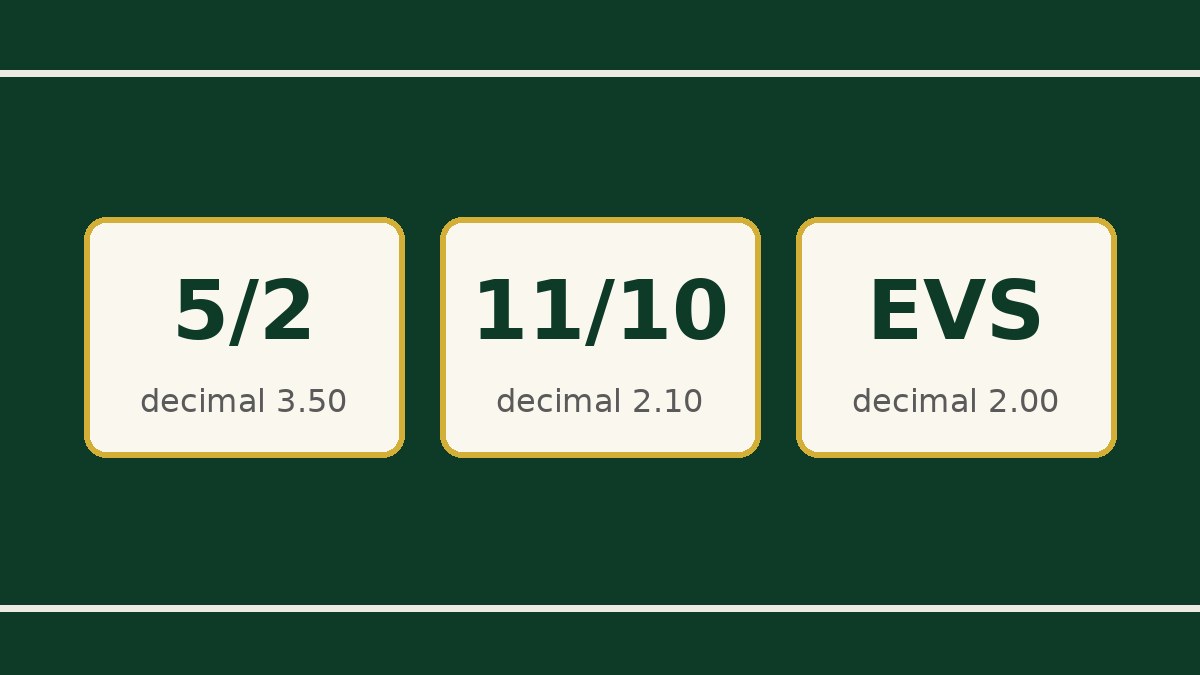
Fractional odds are how British and Irish racing has always quoted prices: 5/2, 11/10, 100/30, evens. Once you know which number is the stake and which is the winnings, every price on a racecard or betting show makes sense. This guide covers how to read them, how to work out a return, how they convert to decimal odds and what chance each price implies. It sits alongside the rest of our horse racing guides.
How do fractional odds work?
The number on the right is what you stake, and the number on the left is the profit you get if the bet wins. You also get your stake back on top.
So 5/2 means £5 profit for every £2 staked. A £10 bet at 5/2 wins £25 profit and returns £35 in total. At 4/1 you win £4 for every £1, so £10 returns £50.
The quick method for any price: divide your stake by the right-hand number, multiply by the left-hand number to get the profit, then add the stake back.
- £10 at 11/4: £10 ÷ 4 = £2.50, × 11 = £27.50 profit, £37.50 returned.
- £10 at 11/10: £10 ÷ 10 = £1, × 11 = £11 profit, £21 returned.
- £10 at 4/6: £10 ÷ 6 × 4 = £6.67 profit, £16.67 returned.
How do you say fractional odds out loud?
Prices are read as “to”. 5/2 is five to two, 11/4 is eleven to four and 100/30 is a hundred to thirty. You will hear these on course and on the racing channels, so it helps to recognise them by ear as well as on screen.
What does evens mean in betting?
Evens, written as Evs, EVS or 1/1, means the profit equals the stake. A £10 winning bet at evens returns £20: £10 profit plus your £10 back. In decimal odds evens is 2.00.
11/10 sits just the other side of evens. It pays £11 for every £10 staked, so it is slightly bigger than even money.
What does odds-on mean?
A horse is odds-on when the price is shorter than evens, so the profit is smaller than the stake. In fractional form the bigger number is on the bottom, as with 1/2 or 4/6. In decimal odds it is anything below 2.00.
You will sometimes hear a price like 1/2 called “two to one on”. It is the same price said the other way round. Prices bigger than evens, such as 5/2 or 10/1, are called odds-against.
What is the difference between decimal and fractional odds?
They describe the same bet. Fractional odds show the profit; decimal odds show the total return for every £1 staked, including the stake. That is why decimal odds are always one more than the fraction worked out.
To convert fractional to decimal, divide the left number by the right number and add 1. 5/2 is 2.5 plus 1, so 3.50. 9/4 is 2.25 plus 1, so 3.25.
To go the other way, take 1 off the decimal and turn what is left into a fraction. 3.25 minus 1 is 2.25, which is 9/4. 1.80 minus 1 is 0.8, which is 4/5.
What chance does a price imply?
Every price carries an implied chance of winning. With decimal odds, divide 100 by the price. With a fraction, divide the right-hand number by the two numbers added together: 5/2 is 2 ÷ 7, or about 28.6%.
Here are some common prices with their decimal equivalent and implied chance:
- 1/2: 1.50 decimal, 66.7%
- 4/6: 1.67 decimal, 60%
- 10/11: 1.91 decimal, 52.4%
- Evens: 2.00 decimal, 50%
- 11/10: 2.10 decimal, 47.6%
- 6/4: 2.50 decimal, 40%
- 2/1: 3.00 decimal, 33.3%
- 5/2: 3.50 decimal, 28.6%
- 3/1: 4.00 decimal, 25%
- 4/1: 5.00 decimal, 20%
- 10/1: 11.00 decimal, 9.1%
- 20/1: 21.00 decimal, 4.8%
Note that 3/1 is a 25% chance, not one in three. The total of all the runners’ implied chances in a race comes to more than 100%. The extra is the bookmaker’s margin, known as the overround, so a price is the market’s view with that margin built in, not a horse’s true chance.
That is the useful part for form study. If your own reading of a race says a horse wins more often than its price implies, the price is bigger than it should be. If not, it is too short. When you look through today’s UK and Irish racecards, thinking in percentages makes it easier to compare a 5/2 shot with a 7/2 shot.
How do fractional odds work on each-way bets?
The place part of an each-way bet is paid at a fraction of the win odds, usually a quarter or a fifth depending on the race. At 10/1 with a quarter the odds for a place, the place part pays at 10/4, which is 5/2. So a £5 each-way bet (£10 in total) on a horse that finishes placed but does not win returns £17.50 from the place part, and the win part loses.
Our guide to how each-way betting works covers place terms and how they change with field size and race type.
What do shortening and drifting mean?
A horse that is backed sees its price shorten, for example from 5/1 to 3/1. One that is weak in the market drifts, for example from 3/1 out to 5/1. If a runner is withdrawn late, winning bets on the others can also be reduced; our explainer on non-runners and Rule 4 deductions shows how that is worked out.
We do not give selections in our guides. The All Sports Tips horse racing tips page is where the day’s selections are posted, each with its price and stake.
Fractional odds FAQ
How do fractional odds work?
The right-hand number is the stake and the left-hand number is the profit. At 5/2 you win £5 for every £2 staked and get your stake back as well.
What is the difference between decimal and fractional odds?
Fractional odds show the profit, and decimal odds show the total return including the stake. Divide the fraction and add 1 to get the decimal, so 5/2 is 3.50.
What is 2.0 in fractional odds?
2.0 in decimal is evens, or 1/1. A £10 winning bet returns £20.
What does evens mean in betting?
Evens means your profit equals your stake. It implies a 50% chance of winning.
What does odds-on mean?
Odds-on means the price is shorter than evens, such as 1/2 or 4/6, so the profit is smaller than the stake. The price implies a better than 50% chance.
Sources: The Jockey Club betting jargon guide and the British Racecourses odds conversion guide. Worked figures are rounded to two decimal places.
18+ only. Please gamble responsibly and read our responsible gambling guidance. For free, confidential support visit BeGambleAware.org.
Leave a Reply