
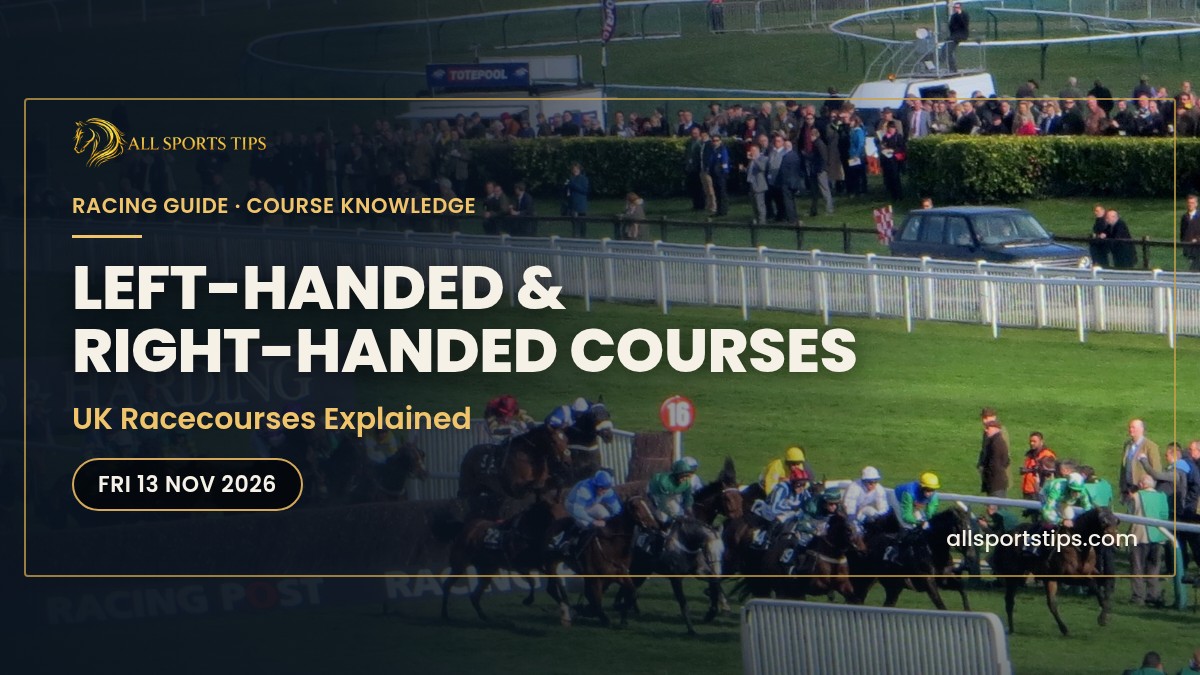
Almost every British racecourse with a round course turns one way or the other. On a left-handed course the runners go anticlockwise, with the rail on their left; on a right-handed course they go clockwise. Some horses handle one way round better than the other, which is why direction is a regular talking point when a horse switches tracks.
This guide lists which UK courses go which way and explains when it matters. It is part of our horse racing guides series.
What is a left-handed racecourse?
A left-handed racecourse is one where the horses race anticlockwise, so every bend turns to the left. A right-handed course runs clockwise, with the bends turning right. Viewed from above, right-handed runners move the same way as the hands of a clock.
Direction only comes into play when a race goes round a bend. A five-furlong sprint on a straight course is the same test whichever way the round course runs, so always check which part of the track a race uses.
Is Cheltenham left-handed?
Yes. Cheltenham is left-handed, and so are both of its main tracks, the Old Course and the New Course. There is also a cross-country course laid out inside them. Whichever course is in use, the runners finish up the stiff climb to the line known as Cheltenham Hill.
The November Meeting, which runs from Friday 13 to Sunday 15 November 2026, is staged on the Old Course, as are the Showcase and the first two days of the Festival. The New Course takes over for the December meeting, New Year’s Day, Trials Day, the April meeting and the last two days of the Festival. Our Cheltenham November Meeting 2026 guide covers the key races this weekend.
The two tracks are not identical. The Old Course is generally seen as the sharper of the two and the New Course as the more galloping, stamina-sapping test, and in two-mile hurdles on the New Course only two flights are jumped in the last seven furlongs. Both are still left-handed and undulating with stiff fences, so a horse that handles one usually copes with the other.
Which UK racecourses are left-handed?
Left-handed tracks are in the majority in Britain. Going by the main round course at each venue, these race left-handed:
- Flat only (turf and all-weather): Bath, Brighton, Chelmsford City, Chester, Epsom, Nottingham, Pontefract, Redcar, Thirsk, Wolverhampton, Yarmouth and York.
- Jumps only: Aintree, Bangor-on-Dee, Cartmel, Cheltenham, Fakenham, Hexham, Kelso, Newton Abbot, Plumpton, Sedgefield, Stratford, Uttoxeter, Warwick and Worcester.
- Both codes: Ayr, Catterick, Chepstow, Doncaster, Ffos Las, Haydock, Lingfield, Newbury, Newcastle, Southwell and Wetherby.
- Fontwell: the hurdles course is a left-handed oval, but the chase course is a figure of eight.
That makes 37 courses that are left-handed throughout, plus Fontwell’s hurdles track. Of the six all-weather tracks, five are left-handed: Chelmsford City, Lingfield, Newcastle, Southwell and Wolverhampton. Our all-weather racing guide covers how their surfaces differ.
Which UK racecourses are right-handed?
Right-handed tracks are fewer, and several of the best known jumps venues are among them.
- Flat only: Beverley and Ripon.
- Jumps only: Exeter, Hereford, Huntingdon, Ludlow, Market Rasen, Perth, Taunton and Wincanton.
- Both codes: Ascot, Carlisle, Kempton, Leicester, Musselburgh and Sandown. Kempton is the only right-handed all-weather track in Britain.
- Right-handed with straight courses: Goodwood, Hamilton, Newmarket’s Rowley Mile and July Course, and Salisbury. Much of their racing is on a straight, so direction only matters in races that use the bends.
Figure-of-eight courses
Windsor and Fontwell’s chase course are figures of eight, so runners turn both ways. Windsor describes itself as one of only two figure-of-eight courses in the UK, and Fontwell calls its chase course the only figure-of-eight jumps track left in the country. Windsor’s longest races take in both a left and a right turn, while shorter races on the round course only bend right.
Does course direction affect a horse’s chance?
It can, but less often than the talk around it suggests. Some horses hang or lean on the bends, and they tend to look happier going the way that suits their balance. Others run to the same level whichever way round they go.
Over jumps it shows up most clearly in how a horse meets its fences. A chaser that consistently jumps out to the right loses ground at every fence on a left-handed track, and may be more fluent on a right-handed one. The reverse applies to horses that jump left.
The important word is consistently. One awkward jump or one poor run going the other way proves nothing. A preference only means something when it shows up over several races run in similar conditions.
How to use course direction in form study
- Start with the track itself. Form at today’s course and distance tells you more than a general record at left-handed or right-handed tracks. The C and CD symbols on a racecard show previous course and course-and-distance winners.
- Read the comments. Look for repeated notes such as “jumped right”, “hung left” or “hung right” in a horse’s form, and check whether they line up with the way the course turned.
- Compare like with like. Chester and York are both left-handed, but Chester is a tight circuit of little more than a mile and York has wide, sweeping bends. Shape, gradients and the length of the straight often matter more than direction.
- Separate straight and round-course form. A win over the straight five furlongs at Doncaster says nothing about how a horse handles a left-handed bend.
- Factor in the draw and the pace. On a tight track the draw and the run to the first bend can matter, and how the pace is likely to unfold shapes who gets a good position on the turns.
Direction is one piece of the picture, not a reason on its own to back or dismiss a horse. Ability, the going, the trip and current form still carry most of the weight.
Left-handed and right-handed racecourses FAQ
What is a left-handed racecourse?
A left-handed racecourse is one where horses race anticlockwise, with every bend turning to the left. On a right-handed course they race clockwise.
Is Cheltenham left-handed?
Yes. Both the Old Course and the New Course at Cheltenham are left-handed, and both finish with an uphill run to the line. The November Meeting is run on the Old Course.
How many left-handed racecourses are there in the UK?
Going by the main round course at each venue, 37 British courses are left-handed throughout, plus Fontwell’s hurdles course. Counts vary slightly between sources because some venues mix straight and round courses, or have a figure-of-eight layout.
Which UK racecourses are right-handed?
Ascot, Beverley, Carlisle, Exeter, Hereford, Huntingdon, Kempton, Leicester, Ludlow, Market Rasen, Musselburgh, Perth, Ripon, Sandown, Taunton and Wincanton. Goodwood, Hamilton, Newmarket and Salisbury are also right-handed where their races use the bends.
Does course direction affect a horse’s chance?
For some horses, yes, especially chasers that jump consistently to one side. Many horses act equally well either way, so look for a repeated pattern before reading much into it.
Sources: checked on 13 November 2026 against Cheltenham Racecourse’s racecourse map page, British Racecourses’ guides to left-handed and right-handed racecourses, Fontwell Park, Royal Windsor Racecourse and the Racing Post’s comparison of Cheltenham’s Old and New courses.
Header photo: “Handicap chase” at the 2014 Cheltenham Festival by Carine06, CC BY-SA 2.0, cropped, darkened and with text added; the header image is shared under the same licence.

18+ only. Please gamble responsibly and read our responsible gambling guidance. For free, confidential support visit BeGambleAware.org.
Leave a Reply